
Radiator Hose Failure: The Inspection Checklist That Catches Problems Before a Customer Finds Them
A car comes in for an oil change. Nothing on the work order mentions cooling system.
The mechanic pops the hood anyway, runs a hand along the upper radiator hose out of habit, and feels it give slightly more than it should. That five-second check just prevented a tow truck call two weeks from now.
Radiator hose failure signs in Philippine vehicles rarely show up as a sudden blowout with no warning. The rubber degrades over months, sometimes years, and it tells the story the entire time if someone bothers to check. The problem is that most shops only look at the hoses when a customer specifically complains about a leak or an overheating dashboard light.
By then, the hose has usually already failed, and what should have been a scheduled P500 to P1,500 replacement becomes an emergency tow plus diagnostic time the shop has to eat or explain.
This article lays out the inspection checklist that catches coolant hose problems while they are still cheap to fix. It is built for the mechanic doing a routine under-hood check, not just for the customer who already smells coolant.
Why Radiator Hoses Fail Faster in Philippine Conditions
Radiator hoses carry hot coolant under pressure between the engine and the radiator, and sometimes to the heater core as well. They are made of reinforced rubber compounds designed to flex with engine movement while holding pressure and resisting heat degradation. That flexibility is also what eventually betrays them.
Philippine traffic conditions push hoses harder than highway driving does.
Stop-and-go traffic in Metro Manila keeps engines running hot for longer stretches without the airflow that highway speed provides, and that sustained heat accelerates rubber breakdown from the inside out. Heat cycles the hose through repeated expansion and contraction, and over time the rubber loses elasticity. Once that happens, the visible signs start appearing well before a failure, if someone is looking for them.
The Inspection Checklist
1. Squeeze Test for Softness
With the engine cold, squeeze the upper and lower radiator hoses between thumb and fingers at several points along their length, not just near the clamps. A healthy hose should feel firm and spring back immediately when released. A hose that feels mushy, spongy, or stays slightly compressed after squeezing has internal degradation, even if the outer surface still looks fine. This is one of the earliest and most reliable signs a hose needs replacing, and it takes about ten seconds to check.
Always run the squeeze test on a cold engine. Hot hoses give a false softness reading because rubber temporarily softens under heat regardless of its actual condition. A hose that feels fine after a warm drive may already be past the point of safe use.
2. Visible Cracking, Especially Near the Clamps
Look closely at the hose surface where it meets the radiator neck and the engine connection point, since these areas flex the most and crack first. Fine surface cracks that look like dried skin are an early warning. Deeper cracks that run perpendicular to the hose length are a sign that failure could happen soon, particularly under the heat and pressure of a long drive.
3. Bulging or Swelling Along the Hose Body
A section of hose that bulges outward, especially when the engine is running and the cooling system is under pressure, indicates the internal reinforcement layer has weakened in that spot. The outer rubber is essentially ballooning because it is no longer being held in shape from the inside. A bulging hose can fail without warning under normal driving pressure and should be treated as a near-term replacement, not a wait-and-see item.
A hose showing visible bulging under running pressure should not leave the shop. The internal reinforcement has already broken down at that point, and there is no reliable way to know how much longer it holds under highway conditions. Tag it for immediate replacement.
4. Glazing or a Hardened, Shiny Surface
Heat exposure over time can cause the hose surface to develop a glassy, hardened texture that looks almost shiny compared to the slightly matte finish of healthy rubber. A glazed hose has lost most of its flexibility even if it has not cracked yet. It will not absorb engine vibration the way it should, which puts more stress on the clamps and connection points.
5. Coolant Residue or Staining Near Connection Points
Even a small amount of dried coolant residue, often appearing as a chalky or crusty buildup near a hose clamp, signals a slow seep that has been happening for a while. The driver may not have noticed a puddle yet because the leak rate is too slow to drip visibly, but the residue confirms the seal has already started failing. This is the kind of sign that customers almost never report because there is nothing obvious to see from the driver's seat.
6. Clamp Condition and Tightness
Hose failure is not always about the hose itself. A loose, corroded, or improperly seated clamp can allow a slow leak even on a hose that is otherwise in good condition. Check that clamps are positioned correctly over the hose barb, not riding off the edge, and confirm there is no visible rust weakening the clamp band.
| Stage | What You See or Feel | Risk Level | Recommended Action |
|---|---|---|---|
| Early | Slight softness on squeeze, faint surface cracking | Low | Monitor, flag for next scheduled service |
| Warning | Visible cracking, glazing, or hardened texture | Moderate | Recommend replacement within the next few weeks |
| Critical | Bulging under pressure, active coolant seepage, spongy collapse on squeeze | High | Replace before the vehicle leaves the shop |
A hose at the Critical stage is a candidate for sudden failure on the road. At that point it stops being a parts cost and becomes a stranded customer, a tow truck call, and a potential engine rebuild conversation that the shop did not cause but may have to help explain.
What Happens When a Radiator Hose Actually Fails
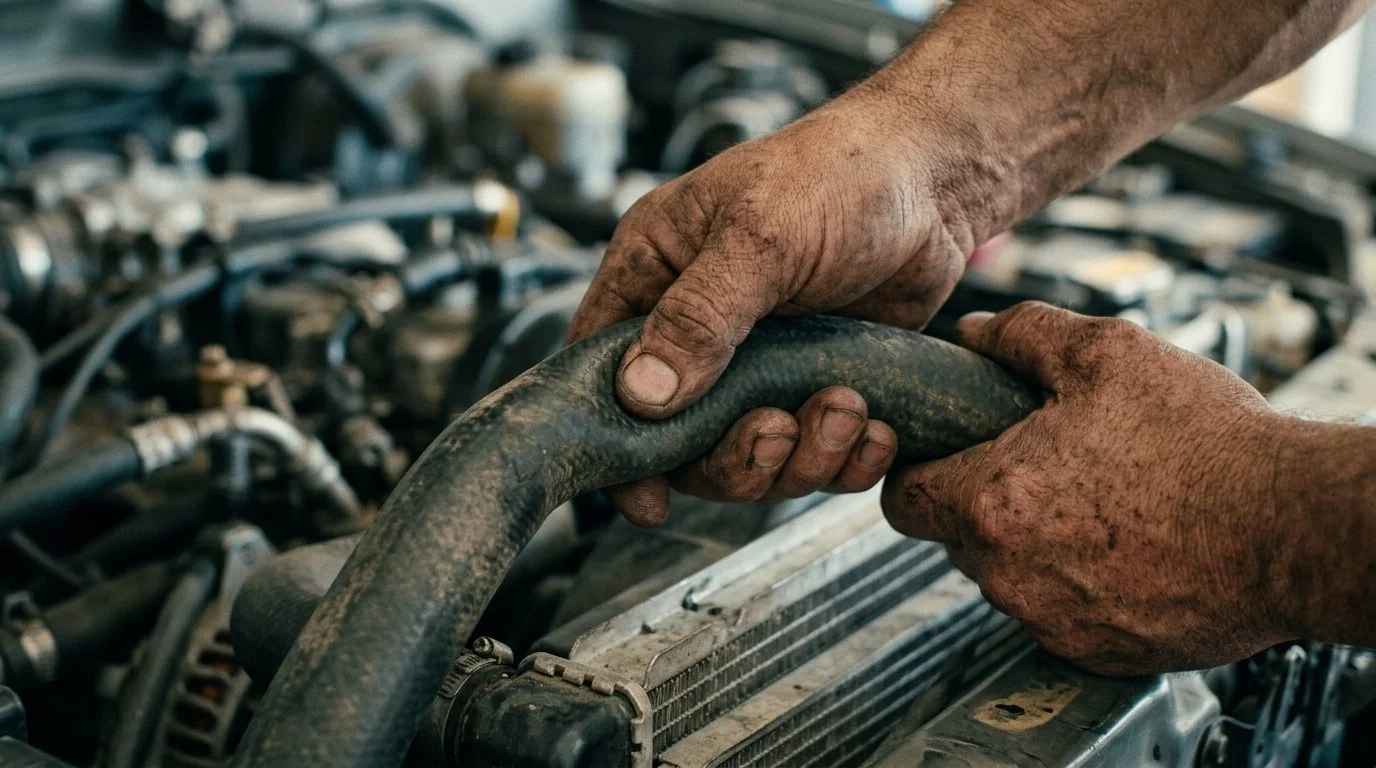
When a hose ruptures or blows off a connection while driving, the cooling system loses pressure and coolant almost immediately.
The engine temperature gauge climbs fast, often within a minute or two, because there is no coolant left to absorb and transfer heat away from the engine block. If the driver does not stop right away, the result can range from a warped cylinder head to a fully seized engine, repairs that run well into the tens of thousands of pesos rather than the cost of a hose and a service call.
Why This Checklist Protects Shop Reputation, Not Just the Vehicle
A customer who gets stranded on EDSA because a radiator hose let go does not remember that the hose was twelve years old and well past its service life. They remember which shop last had the hood open. Running this checklist as a standard part of any service visit, even one unrelated to cooling system work, is a low-cost way to catch a failure before it becomes the customer's emergency and the shop's reputation problem. The mechanics who consistently catch these signs early are the ones customers come back to and recommend, because the customer experiences a shop that prevents problems rather than one that only reacts to them.
This same habit of routine inspection applies across the cooling system. The signs covered in our water pump failure guide follow a similar pattern: small, catchable warnings that show up well before the dramatic failure does.
Frequently Asked Questions
Q: How do I know if my radiator hose needs replacing?
A: Squeeze the hose when the engine is cold. If it feels soft, spongy, or stays compressed after you let go, it needs replacing. Combine that with a visual check for cracking, bulging, or glazing near the clamps for a complete read.
Q: How often should radiator hoses be replaced in the Philippines?
A: There is no fixed mileage rule, since heat exposure and driving conditions matter more than odometer reading. As a general guide, hoses showing Warning-stage signs on the table above should be scheduled for replacement, and any vehicle over five years old in regular Metro Manila traffic is worth a hands-on check at every service visit.
Q: Can a radiator hose fail without any leak showing first?
A: It can happen, but it is uncommon. Most failures are preceded by softness, cracking, or glazing that a hands-on check would have caught. Sudden failures with no warning usually trace back to a hose that was never physically inspected, only looked at from a distance.
Q: Is a bulging hose always an emergency?
A: A hose bulging under running pressure should be treated as high priority and replaced before the vehicle is driven again under normal conditions. The bulge means the internal reinforcement has already weakened, and there is no reliable way to predict how much longer it will hold.
Cooling System Parts from AllMakes Philippines
AllMakes Philippines is a cooling system specialist supplying OEM-sourced coolant hoses, radiators, water pumps, and related components for European, Japanese, and American vehicles.
European vehicle coverage spans all models, including BMW, Mercedes-Benz, Audi, Porsche, Volkswagen, and MINI. Japanese and American vehicle coverage focuses on the SUVs and pickups that Philippine shops and fleet operators work with most, including Toyota Fortuner and Hilux, Mitsubishi Montero and L200, and Ford Everest and Ranger.
Learn more about AllMakes PH products here.
Phone: +63 (02) 86620736 | Email: sales@allmakesph.com